A note from the CEO: Spring 2026 update
An update from CEO Alana Barlow

As the days lengthen in South Australia, so does the pace at Sparc Hydrogen. Since our last note we have progressed our collaboration with SunHydrogen, closed out a full winter of operating data at SHARP, joined the APAC Hydrogen Summit in Adelaide, added new jurisdictions to our patent portfolio, and been named a finalist in the state’s premier science and innovation awards. A short summary of each is below.
At a glance
SunHydrogen collaboration is well underway; Phase 1 laboratory testing has delivered excellent early data demonstrating increased hydrogen production yields, utilising Sparc Hydrogen’s reactor technology.
SHARP completed its first winter of continuous operation, with the spring and summer program now underway.
We hosted a successful SHARP site tour on 2 September 2026 as part of the APAC Hydrogen Summit held in Adelaide on 3 and 4 September.
Generation 1 reactor patents granted in three further jurisdictions: Japan, Saudi Arabia, and South Africa.
Photocatalyst sourcing strategy broadened to incorporate high-performing PEC and IPV-E materials, with a new Manager of Advanced Materials appointed in August.
Several new materials producers were identified during the quarter, with new materials procurement underway for lab testing.
Finalist, 2026 South Australian Science Excellence and Innovation Awards.
SunHydrogen collaboration: Larger hydrogen yields as Phase 1 progresses
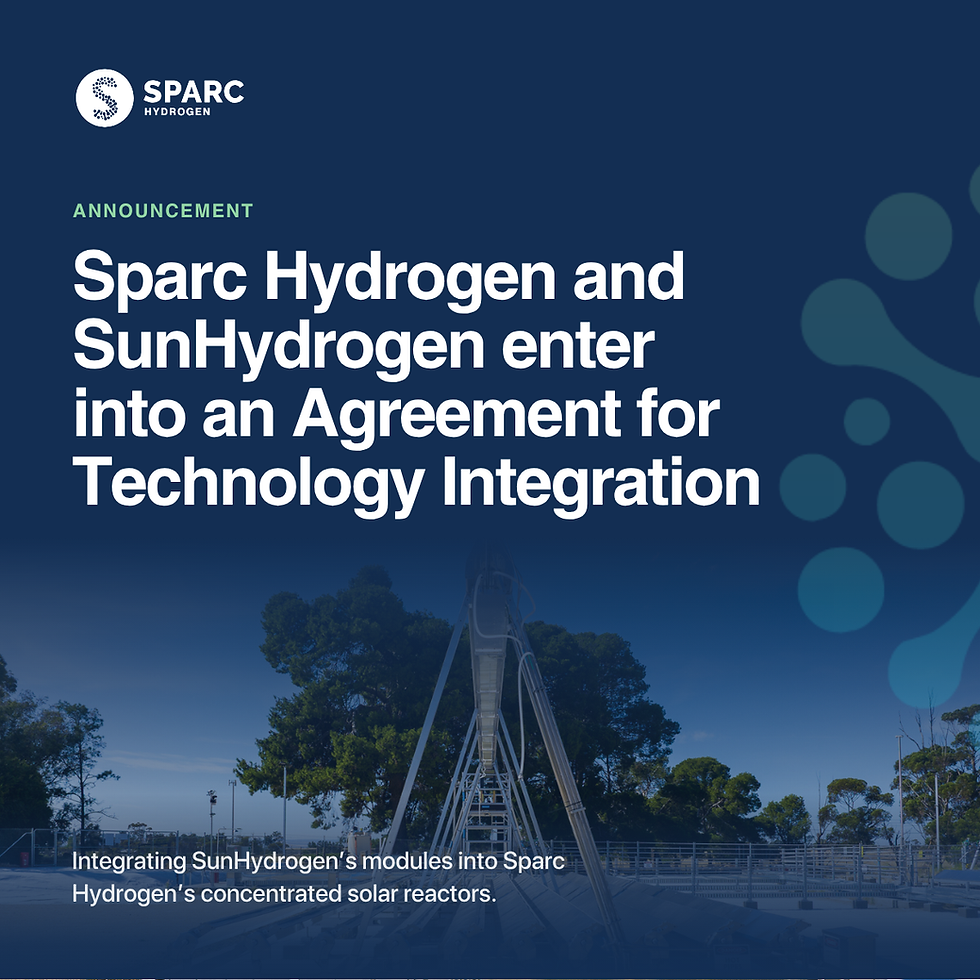
In August we announced a 24-month Collaboration and Mutual IP Protection Agreement with SunHydrogen, Inc. (OTCQB: HYSR), integrating their high-performing photoelectrochemical water splitting modules with our concentrated solar reactors under a milestone-based, phased structure.
We are well underway in the first phase of our collaboration, which involves laboratory testing at increasing solar concentrations. As announced in August, we achieved a key milestone in generating >10% Solar to Hydrogen efficiency (STH) utilising SunHydrogen’s modules. That efficiency figure is only part of the story. SunHydrogen’s modules are performing well in Sparc Hydrogen’s reactors under increased solar concentration. Hydrogen production per module rises substantially under concentration.
Increasing hydrogen output per module has the potential to improve system economics and ultimately reduce the levelised cost of hydrogen (LCOH) for the combined technologies.
We are looking forward to concluding Phase 1 in October 2026 and moving into Phase 2, which involves optimising the integration of our respective technologies.
SHARP: winter data in, spring and summer program ahead
SHARP continues to operate at Adelaide University’s Roseworthy Campus. Over the winter months we have kept the facility running consistently and reliably, collected valuable operating data under lower irradiance and cooler conditions, and hosted a series of site tours for partners, government, and prospective collaborators.
The winter dataset is important. It fills out the picture of year-round performance in a way that no accelerated test bench can, and we are equally looking forward to the spring and summer testing program ahead. The upcoming campaign will push the facility across a wider operating envelope, validate ongoing improvements and generate the data we need to underpin our next-generation reactor design for higher performing water-splitting materials.
APAC Hydrogen Summit: signals of a maturing industry
The APAC Hydrogen Summit in Adelaide on 3 and 4 September brought together a substantive cross-section of the industry. What stood out was the profile of the delegates: project developers with assets in flight, technology suppliers with deployed equipment, and offtakers actively working through commercial arrangements.
Two shifts in the industry conversation were clear. First, the discussion has moved beyond hydrogen as an end product to how it integrates into higher-value chains, including green iron and steel, fertiliser, explosives, and the decarbonisation of existing industrial supply chains. Second, there is a growing appetite for production pathways that do not rely on grid electricity and electrolyser stacks alone. Sparc Hydrogen sits at the forefront of that conversation.
We were encouraged by the reception to our technology and the potential we see for concentrated-solar water splitting to change the cost dynamic of clean hydrogen production. Alongside the Summit, we hosted a successful site tour of SHARP on 2 September, which gave delegates the chance to see the facility in operation.

Patents: Generation 1 reactor protection extended
Our Generation 1 reactor now has patent protection granted in three further jurisdictions: Japan, Saudi Arabia, and South Africa. This complements the protection we have previously secured in Chile and Morocco, and continues to build out a broad IP position, as we await patent protection from a further 12 jurisdictions where concentrated-solar driven hydrogen is most likely to be deployed at scale. Broadening our water-splitting materials strategy
Our reactor is a platform for driving water-splitting reactions with concentrated sunlight. Historically, our materials work has focused on photocatalysts. Over the past year we have broadened that strategy to include photoelectrochemical (PEC) cells and integrated PV-electrolysis (IPV-E) systems. These are all direct solar water-splitting technologies, and our reactor is well suited to hosting each of them.
The rationale is simple. A broader high-performing materials pipeline de-risks the path to commercial-scale hydrogen production and lets us match the best-performing cell technology to each deployment context. It also opens up complementary opportunities to lift the performance of PEC and IPV-E systems that were not originally designed to run under concentrated light.
To support this expansion, we have recently welcomed Sam Core as our Manager of Advanced Materials, bringing dedicated expertise to sourcing and evaluating the next generation of materials for our platform.

On the road: Japan
In October we head to Tokyo to continue building awareness of our technology and to develop relationships with key stakeholders in Japan, a market that continues to sit at the centre of the global clean hydrogen conversation.
Alana Barlow, CEO, will speak at HENCA Tokyo 2026 on 14 and 15 October, on invitation from the Tokyo Metropolitan Government. HENCA is TMG’s international hydrogen conference, bringing together policymakers, industry, and researchers from across the region.
We have also recently joined as a member of the Australia-Japan Business Co-operation Committee (AJBCC). Alana will attend the AJBCC’s annual conference in Chiba during the same trip, giving us direct access to a well-established network of Australian and Japanese businesses working on trade, investment, and technology partnerships.
Alongside these events, we will be meeting with existing partners and prospective collaborators in Japan. If you would like to meet with us while we are in Tokyo, please get in touch.
Recognition: SASEIA finalist
Our team has been named a finalist in the 2026 South Australian Science Excellence and Innovation Awards, in the category of Excellence in Collaborative Innovation. The nomination recognises the work our team has done to take photocatalytic water splitting from laboratory concept to a fully commissioned pilot facility.
This is skilled, patient, technically demanding work, and it is being recognised because of the calibre and dedication of the people doing it. Winners will be announced at the Awards celebration in Adelaide on 12 November 2026.

Celebrating our team
Sparc Hydrogen is a team of specialists doing work that few others in the world are doing. In the coming months we will be publishing short profiles of the people who make this technology real: the researchers, engineers, and operators whose combined expertise sits behind every result we share. We are proud of the calibre of the team we have built, and we look forward to introducing them to you properly.

Meet the team: Tatyana Osorio Rendon
“The future has come, and we are part of it.”
Tatyana works on one of the most consequential problems in photocatalytic water splitting: making the photocatalyst coating last.
Tatyana has been part of the team working to extend how long the coating holds up, and she’s careful to give credit where it’s due. “It has been a whole team effort. I am glad that by working together, we have found solutions to make the coating last longer.”
Ask Tatyana what kind of person does well here and she’ll tell you it’s someone who listens. “Everyone is heard. It doesn’t matter if you are the CEO or you just recently started... your contribution is greatly appreciated.”
Nobody has built this before, so there’s no playbook to fall back on. Tatyana reckons that’s half the appeal.
Thank you Tatyana for all your hard work!
As always, thank you for your interest in our work. If you would like to visit SHARP, discuss a potential collaboration, or simply keep in touch, my team and I would welcome the conversation.
Alana Barlow Chief Executive Officer, Sparc Hydrogen